Showing posts with label mcgee. Show all posts

Thursday, September 27, 2012

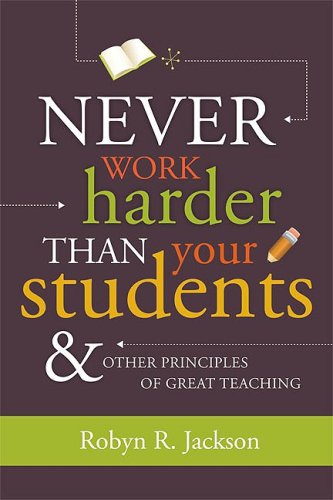
Never Work Harder Than Your Students: Chapter 2

As part of our transition program for teachers who are new to the district in their 2nd and 3rd year we are having specific professional development centering around differentiation.

We are using the book "Never Work Harder Than Your Students" to also infuse some culturally responsive and relevant teaching practices.

The chapter is titled: "Know where your students are going."  This chapter almost seems to mimic the work done by Marzano in the Art and Science of teaching, as well as Wiggins and McTighe's work on Understanding by Design.  Notice the connections.

Here are my takeaways from the chapter:

  • Learning goals are more than what students do during a day, it's about what learning they should walk away with
  • Teachers know objectives are important, but how to create objectives, how to determine whether or not student have achieved them remains for many to be very difficult
  • Standards are your "final destination"

  • Think about planning in this way:
    • What do we, my state, and my community want kids to know by the end of this year/unit (learning goals)
    • Develop assessments to determine mastery
    • Develop scoring guides to measure proficiency and to utilize for feedback
    • Develop lessons/activities that lead to proficiency

  • Develop learning goals with the focus of whether the learning is a content or a process
  • Challenge your students to exceed the standards and provide room for differentiation
  • Understanding what the standard is allows you to:
    • think through the goal
    • determine if it's content or process, which leads to developing or finding appropriate lessons/activities
    • think through steps to accomplish or acquire the content or skill
  • Make learning goals concrete = how will you measure whether or not students have achieved this goal.

BRIEF ASIDE:
I do not like using the word "understand" in my learning goals.  You cannot measure understanding.  Replace the word understand with what you are asking kids to understand specifically and communicate how you will measure that understanding.  From this I usually pull out my DOK wheel and begin to seek out the specific word, phrase, or skill we want kids to be able to answer.  This way we know what mastery looks like, sounds like, or feels like in our classroom.

  • How to make learning goals concrete:
    • How will it be measured
    • build criteria for mastery (rubric)
    • break down into smaller chunks (steps to acquisition or success)
  • Goals should represent the floor (minimum expectations) not the ceiling.
  • Goals representing the floor allows for differentiation and extension opportunities
  • Determine how to:
    • know what it looks like when students have mastered the objective
    • how to collect evidence of that mastery
    • how to collect evidence over time
  • Work with a team to determine exemplars and acceptable evidence of mastery
  • The test is not the be-all-and-end-all BUT it is the "clearest articulation of the objective"
Great resources to support teachers found here: http://mindstepsinc.com/masterteacher/

Friday, April 2, 2010

Maybe we need more "Childish thinking"

Here is a 11 year old girl speaking on creativity, bold ideas, trust and "Childish Thinking."

I love what is said here about adults trusting students. There is something scary about handing the keys to the classroom over to our students, but why not give up control. Let the students drive. Sure you may end up in a place you never intended, but how cool would it be to open up to a world you never imagined. Watch this presentation, get inspired by this brilliant mind and see that she is just as brilliant as the kids I see every day. The difference, our school system doesn't trust our kids.

So think bold, be creative, love the unknown, hand over the keys, you might just be inspired......

The way progress happens is that new eras improve on generations that came before you.

Monday, March 22, 2010

What I hate about powerpoint...

After attending many conferences recently and presenting in class myself I'm noticing a trend in powerpoints and presentations that are a little scary to me. Presenters and lecturers are getting boring....

Reading up on power point I have come across some REALLY funny thoughts on this topic and adapted some rules that I'm publishing simply for my own benefit. I want to publish these so that I can be better at presenting information to a group. SO hold me to these, make sure I don't do them and have some fun with the rules. Comment away, add more rules for me to follow:

What I hate about power point adapted from: http://jeremyharmer.wordpress.com/2010/03/20/10-things-i-hate-about-powerpoint/


1 Powerpoint as lecture notes
Make it interesting don’t use the power point and stare at your power point while you talk. If you don’t know what yu are going to say, maybe you shouldn’t be the one saying it…

2 Visual assault
“Pictures, flashes, whizzy entrances, funny faces. It can all get far far too much. I’ll need to re-evaluate what I do with pictures and animation.”

3 Aural assault
“Thwack! Zing! Bzzzz! Kerpow! Wow. Is it too much?”

4 Bullet points
“If I never see another bullet point again I will be
• Happy
• Relieved
• Surprised
They’re everywhere in Microsoft’s Powerpoint template and they screw up the hierarchy of information. And they’re boring.”

5 Powerpoint backgrounds
Don’t use the ones given to you, find some of your own. Or better yet, use black or white and use the imags on the screen as the excitement. Think about an Art Museum, what colors are the walls? WHITE! Why? TO NOT TAKE AWAY FORM THE ART!

6 Early closing
“Leave the last screen up there until people have left the room. It’s good manners.”

7 Lecturers who stand in front of the projector
Just don’t do it..

8 Lecturers who are stuck to the computer
Get out, walk around be yourself. Unless you are boring then be someone else…

9 Technology experts

“fitting the technology to the child, not the child to the technology as the British academic Susan Greenfield said in the House of Lords (Britain’s second legislative chamber) the other day.”

Basically don’t make this overcomplicated or try to WOW the crowd unless you are giving a presentation on WOWing. Keep t simple and not distracting.


10 Technology failure
Prepare for it and have a back up plan in case your powerpoint doexn’t work.


My Final thoughts...

If you are like me….be creative with your presentation, and censor those around you (namely me) to not be too creative. Don’t limit yourself to power point there are a lot of great resources out there that will get your point across too. In fact some of the best presentations I’ve seen was someone simply flipping through their Flickr images. Think about it!

Great video!