Showing posts with label Robyn Jackson. Show all posts

Thursday, November 1, 2012

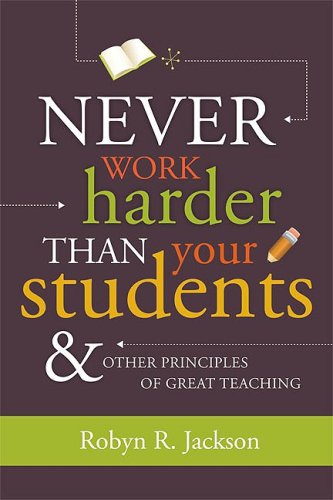
Never Work Harder Than Your Students: Chapter 3

We are doing a book club with our 2nd and 3rd year teachers in our district and reading the book Never Work Harder than your students.

Chapter 3 could be summed up as:

If you don't believe in yourself, who can you believe in?


Some of the main Take-aways I have from chapter 3 are as follows:


  • We drag kids through curriculum
  • We need to look at the expectations we have for ourselves before we can expect things from kids
  • The difference between the expectation and the standard is:
    • Standard is the bar
    • Expectation is your belief that the students can reach the bar
  • Just because you raised the standard doesn't mean that you have also altered your belief that kids can reach those standards.
  • If you believe students won't meet the standard, then that belief will play out in your classroom.
  • An expectation is the confidence that something will happen
An expectation is what you get when you multiply the probability of an occurrence and the value of that occurrence.

  • Beliefs are what we think is true
  • Values are what we think something is worth
  • Our expectations are the intersection between what we believe about our teaching situation and our own abilities to handle it and what we believe is important.


  • Blind belief in our own talent
  • Bet to take anything and turn it into something better
Teachers go to work believing they will end up with a masterpiece, not because the raw material they are working with has some innate potential but because of the power of their own ability to create a masterpiece.


It's about you...
  • Students pick up on our expectations fairly quickly.  They then formulate judgements about the kind of teacher we are and decide how hard they will work in our classroom
  • If we believe in the student, we will pull out all the stops.
  • If we are not confident in our ability, we will lower our expectations
  • lowered expectations is a self-protective measure
  • You want to raise expectations of your students, you first have to raise your expectations of yourself
  • Rather than focus on the problem, focus on how to solve the problem
Stockdale Paradox
  • Optimism creates despair
  • Never confuse faith that you will prevail in the end with the discipline to confront the most difficult of reality.
Have faith in yourself
  • If we believe what we are doing is important, we are more likely there is a way to prevail
  • Faith based on your ideals, what you believe is important
  • Do you value your students following your rules, being quiet and cooperative?
  • Do you value engaging activities with the material and learn to be critical thinkers and effective communication.
  • What do you value?  When you determine what you value, you will determine your faith...
Confront your reality
  • The way we decide what to focus on is what we value.
Our beliefs function as a filter through which we sift our reality.
  • Our decisions are based on our beliefs and the magnitude of our teaching task as well as our own abilities.
  • Asking the right questions will grant you the opportunity to change your beliefs or let them be challenged.
  • Be humble enough to know that you don't have all the answers
  • Be willing to "stop" doing something you are doing...
  • When you get data or information do you use it as an opportunity to blame someone or to improve?
Whole Equation
  • Balance your focus on both sides of the paradox
  • What can I do today to move toward my goal despite the reality of my circumstances?
  • How do you see your individual reality?

Wrap it up...

If a student is failing, then it means that I haven't found the right way to get through to them.

Thursday, September 27, 2012

Never Work Harder Than Your Students: Chapter 2

As part of our transition program for teachers who are new to the district in their 2nd and 3rd year we are having specific professional development centering around differentiation.

We are using the book "Never Work Harder Than Your Students" to also infuse some culturally responsive and relevant teaching practices.

The chapter is titled: "Know where your students are going."  This chapter almost seems to mimic the work done by Marzano in the Art and Science of teaching, as well as Wiggins and McTighe's work on Understanding by Design.  Notice the connections.

Here are my takeaways from the chapter:

  • Learning goals are more than what students do during a day, it's about what learning they should walk away with
  • Teachers know objectives are important, but how to create objectives, how to determine whether or not student have achieved them remains for many to be very difficult
  • Standards are your "final destination"

  • Think about planning in this way:
    • What do we, my state, and my community want kids to know by the end of this year/unit (learning goals)
    • Develop assessments to determine mastery
    • Develop scoring guides to measure proficiency and to utilize for feedback
    • Develop lessons/activities that lead to proficiency

  • Develop learning goals with the focus of whether the learning is a content or a process
  • Challenge your students to exceed the standards and provide room for differentiation
  • Understanding what the standard is allows you to:
    • think through the goal
    • determine if it's content or process, which leads to developing or finding appropriate lessons/activities
    • think through steps to accomplish or acquire the content or skill
  • Make learning goals concrete = how will you measure whether or not students have achieved this goal.

BRIEF ASIDE:
I do not like using the word "understand" in my learning goals.  You cannot measure understanding.  Replace the word understand with what you are asking kids to understand specifically and communicate how you will measure that understanding.  From this I usually pull out my DOK wheel and begin to seek out the specific word, phrase, or skill we want kids to be able to answer.  This way we know what mastery looks like, sounds like, or feels like in our classroom.

  • How to make learning goals concrete:
    • How will it be measured
    • build criteria for mastery (rubric)
    • break down into smaller chunks (steps to acquisition or success)
  • Goals should represent the floor (minimum expectations) not the ceiling.
  • Goals representing the floor allows for differentiation and extension opportunities
  • Determine how to:
    • know what it looks like when students have mastered the objective
    • how to collect evidence of that mastery
    • how to collect evidence over time
  • Work with a team to determine exemplars and acceptable evidence of mastery
  • The test is not the be-all-and-end-all BUT it is the "clearest articulation of the objective"
Great resources to support teachers found here: http://mindstepsinc.com/masterteacher/