Showing posts with label objectives. Show all posts

Thursday, September 27, 2012

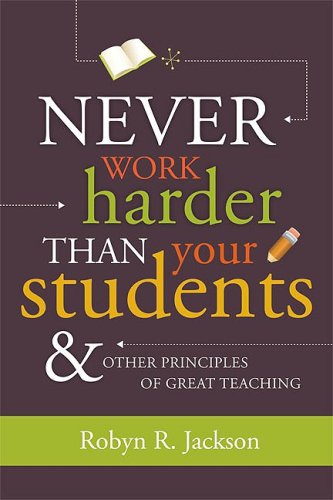
Never Work Harder Than Your Students: Chapter 2

As part of our transition program for teachers who are new to the district in their 2nd and 3rd year we are having specific professional development centering around differentiation.

We are using the book "Never Work Harder Than Your Students" to also infuse some culturally responsive and relevant teaching practices.

The chapter is titled: "Know where your students are going."  This chapter almost seems to mimic the work done by Marzano in the Art and Science of teaching, as well as Wiggins and McTighe's work on Understanding by Design.  Notice the connections.

Here are my takeaways from the chapter:

  • Learning goals are more than what students do during a day, it's about what learning they should walk away with
  • Teachers know objectives are important, but how to create objectives, how to determine whether or not student have achieved them remains for many to be very difficult
  • Standards are your "final destination"

  • Think about planning in this way:
    • What do we, my state, and my community want kids to know by the end of this year/unit (learning goals)
    • Develop assessments to determine mastery
    • Develop scoring guides to measure proficiency and to utilize for feedback
    • Develop lessons/activities that lead to proficiency

  • Develop learning goals with the focus of whether the learning is a content or a process
  • Challenge your students to exceed the standards and provide room for differentiation
  • Understanding what the standard is allows you to:
    • think through the goal
    • determine if it's content or process, which leads to developing or finding appropriate lessons/activities
    • think through steps to accomplish or acquire the content or skill
  • Make learning goals concrete = how will you measure whether or not students have achieved this goal.

BRIEF ASIDE:
I do not like using the word "understand" in my learning goals.  You cannot measure understanding.  Replace the word understand with what you are asking kids to understand specifically and communicate how you will measure that understanding.  From this I usually pull out my DOK wheel and begin to seek out the specific word, phrase, or skill we want kids to be able to answer.  This way we know what mastery looks like, sounds like, or feels like in our classroom.

  • How to make learning goals concrete:
    • How will it be measured
    • build criteria for mastery (rubric)
    • break down into smaller chunks (steps to acquisition or success)
  • Goals should represent the floor (minimum expectations) not the ceiling.
  • Goals representing the floor allows for differentiation and extension opportunities
  • Determine how to:
    • know what it looks like when students have mastered the objective
    • how to collect evidence of that mastery
    • how to collect evidence over time
  • Work with a team to determine exemplars and acceptable evidence of mastery
  • The test is not the be-all-and-end-all BUT it is the "clearest articulation of the objective"
Great resources to support teachers found here: http://mindstepsinc.com/masterteacher/

Tuesday, December 1, 2009

How my teaching has changed since Standards Based Grading...

When I first started teaching high school chemistry all I had was a textbook and a mentor. I was instructed to follow my mentor’s lesson plans and just do what he did. We used the textbook as gospel. We taught exactly what was in the textbook, in the exact order it was written, with very few exceptions. We labored the students with worksheets and problems from the textbook. Even our tests were copied straight from the resources provided. After a few years of textbook adoptions and curriculum changes as a result it became clear to me that the textbook was almighty and whatever it says, goes.

At the time I began teaching in Kirkwood I was enrolled in a class called Curriculum Analysis and Design. This is where I learned about “Backwards Design” by Wiggins and McTighe. This helped me begin to write learning goals for each of my units. These goals were my way of informing students of what they were going to learn, how they were going to learn it, and exactly how they were going to be evaluated. After many years of revising, our sixth-grade science curriculum is now sound, created through backwards design and supported by various textbooks and resources.

We use our GLEs to write learning goals and accompanying scoring guides. We evaluate students using these scoring guides in a standards based environment. We use the learning goals to write our assessments. Our assessments drove us to adopt resources and textbooks. These resources and textbooks led us to develop daily laboratories and activities to support student learning. The process of developing, revising, and communicating the curriculum never ends for us. With the support of our science facilitator and compassionate sixth grade science teachers we have created an excellent curriculum and have impacted student learning and achievement.

Every day I use the learning goals we created as a “look for” in my classroom. A look for is a guiding statement that focuses my attention on what students are learning each day. I carry a class roster with the unit’s learning goals at the top with me every day. I take diagnostic data on my students, give feedback, and document that information into an un-weighted category in my grade book. This way I can keep track of student progress, help students who need it, and challenge those who have already met the standard. I evaluate each student using the scoring guide designed for that goal. This allows me to ensure that each student is achieving the learning goals set forth by our curriculum and by the state of Missouri. Since this data correlates with the GLEs, we can also correlate performance to our end-of-unit exams, and further onto the MAP assessment.

As Stephen Covey wrote in 7 Habits of Highly Effective People, “to begin with the end in mind means to start with a clear understanding of your destination.” The learning goals are my destination and my students know that. The design of the curriculum has made me a better teacher by allowing me to ensure that every day my lesson has a goal. Students are being evaluated and are receiving feedback every class based on their performance on a measurable objective. Learning goals are a great way to keep me organized and to keep students focused on achievement each day. I’m happy to say that the students in my classroom are better off today because of these changes and I’m excited about where we are headed as a 6th grade science department.

Check out my website to see what we do (http://www.kirkwoodschools.org/faculty/mcgeech/), and soon you can check out our 6th grade science Moodle page to see all of our curriculum materials.