Showing posts with label leadership. Show all posts

Tuesday, October 27, 2015

The importance of scheduling the parade...

I live in St. Louis.  We are not afraid to host a parade, we've done it a lot lately in honor of the St. Louis Cardinals.  Here's an image from the 2011 World series parade:

I was listening to the latest edition of the EntreLeadership podcast when Dave Ramsey said something that made perfect sense.

Here's the episode link: https://www.entreleadership.com/podcasts/les-parrotthow-conflict-can-help-you-wi, Dave's interview starts 24 minutes into the podcast.

If you aren't planning to win, you're planning to fail.  If you're not planning the celebration, will you set yourself up for a win?

Dave's exact quote:
"You don't schedule a loss, you schedule a win"

I'm working on our school's Comprehensive School Improvement Plan and couldn't help but think about that statement.

Sure we have a goal, a scale for measurement, and action steps to accomplish the goal, but do we have a date for the celebration?  How will we celebrate?


Whenever you start a task, a goal, an assignment, a unit, a season, a game, think about this and plan for it: How will we celebrate?

Sunday, June 22, 2014

Stop saying you're busy.

Stop it, just stop it right now.  Eliminate the phrase "I'm Busy," from your mind.

Imagine this.

You're walking down the hallway and someone asks you how you're doing.  You reply without even thinking, "I'm busy."

Stop it.  Stop it right now.

When you say you're busy here's what you're really saying...

I'm working really hard.  I have too much on my plate right now.  I planned poorly and can't stop to talk to you.  I'm prioritizing what I'm going to over building a relationship with you.  I'm also REALLY important and you should think about that when you say "Hi" to me in the hallway.


Imagine this too.

You get a phone call from a colleague/friend asking you if you can do this task to help them out.  You reply, "I could but I'm really busy right now."

When you say you're busy here's what you're really saying...

I poorly planned my own projects or I don't even like you enough to help you out.  I'l help you with your task but I'll reach back out after all of my other work is complete.

Finally, imagine this...

You're on the phone checking you're voicemail and your get one from your grandmother.  She just wants to check in and she says it, "I know you're busy."

When she says you're busy here's what she's really saying...

I haven't heard from you in a while, I miss you, I don't feel like a priority.  


Stop it, Just Stop it. Stop it this instance.

How to combat "Busy"

Saying your busy implies you're misguided, frantic, walking hard, but not towards a goal.  You have a lot to do, we all do.  But you know what successful people do?  They do this:
  1. Set yearly goals in all aspects of their life. (See seeking balance)
  2. Prioritize tasks
When a new "to do" list item is presented.  

Successful people check: 
1.  Does this get me closer to my goals?  If Yes, it goes on the list, if no, it gets omitted/deleted.  NOTE: some things like going to the grocery store or folding laundry do make it on the list of "life maintenance."

2.  How will it get prioritized?  Will it become more important or less important than the tasks that are already there? NOTE:  If the item takes less than 2 minutes to complete, do it now.


When you're doing busy work, you're working on things that are misaligned with your mission.  The items are NOT moving you closer to your professional or personal goals.  Keep focused.

Stop saying you're busy, focus on your goals and work to achieve them.

Resources:


Saturday, September 29, 2012

Two words I should never read....

I have had the pleasure of being on two very impactful strategic planning teams.  Being able to bring together community members, board members, educators, students and administrators all in the same room and creating a vision for the future is life and career-changing.

Being a part of those two processes has changed me as an educator because I was a part f a team that created, authored, curated, and gave words to what we as a community believe, value, and desire for our students and our nation.

As part of the process we determined what factors impact our students and community.  Think of it like a SWOT activity.

We recorded our beliefs about students and education as a whole.

Throughout this entire week-long process together we were crafting our mission and vision.  I first had to understand that those were two different things.

Finally if we were to achieve our mission/vision, how would we get there.  What would be our charge and how would we progress.  The key to this phase of the process is to not think about today, but think of the end product.  What will education look-like, sound-like and be-like for students when we achieve our actions.  Challenging yourself to look at environment that doesn't exist yet is not an easy task and requires talented people to move you out of your comfort zone.

This brings me to the reason for my post.  I just read a district's strategic plan and two words I read should never be included:

Maintain
and
Adequate

I struggle with both of these words because it's not strategic and it's not a plan.  Status quo is not a vision for the future.

As I was challenged by Heidi on Twitter (who is awesome by the way, you must give her a follow!), 


Then it's not a part of the "strategic plan."  It would become a part of your beliefs about what impacts student performance or school and community environment and that you know it works and it is valued.  

A strategic plan is a vision for the future, what you want for the generations ahead of us.  A careful consideration of what we value, what we want and what we believe. 

I know innovation isn't for every community.  I know change is scary.  If status quo is a belief and good enough is valued as "strategic" we are missing a wonderful opportunity to grow, be challenged and provide for all students.

Wednesday, September 7, 2011

Learning Timeline

Currently wrapping up my doctoral studies, an assignment was to think back to your educational career.  Remember the things that shaped you, molded you, and created the leader, learner, and educator you are today.  Keeping that in mind I went searching for the perfect web 2.0 tool to create my educational timeline.  I settled on Timetoast.com.


Although I like the interface and the ability to add pictures, links, etc.  I struggled with the inability to PRINT and analoge copy.  It was a fun assignment and seeking the right tool was even more fun.

Special thanks to Bob Dillon (no not that Bob Dillon), Justin Tarte and David Kapular (Top 10 timeline tools was a great resource) for supplying some of the resources and inspiration.


Friday, May 13, 2011

Learning about Leading from a General

I watched this TED talk by General Stanley McChrystal and was impacted by some of the words he said when thinking about leadership, listening, leading, and trusting.

How can educational leadership learn from these very military ideas, from an uber-military person?  Simple.

General McChrystal has some real poignant moments in his TEDtalk for me that got me thinking.

1.  Leaders can let you fail, without being a failure.

I was in a job interview yesterday and kept thinking about this statement.  A good coach, facilitator, administrator and/or leader is someone that will be there by your side.  They will be there watching you fail, allowing you to fail, facilitating the learning process, reflecting with you, but never let you be a failure.

Listen, I know, failure sucks.  But there is beauty in failure.  I learned about it the tough way and began to really believe in what I do day in and day out to make myself a better teacher and better person.

As a leader you have to allow for failure but most importantly be there for your students, colleagues and staff and support them through that process.  Great leaders can let you fail.  Great leaders will support you through trying something new in your classroom, being their for you to reflect and helping you get better in the end.  Failure is not a destination, it's often just a detour on the road to where you want to go. We often find that to ever truly succeed we must at one point fail, the key is to surround yourself with great leaders that support you through that process and celebrate your growth in the end.

Some great resources on failure and how to change your view and celebrate it instead of lament it:

Fringe benefits of Failure - J.K. Rowling

On being wrong - Kathryn Schulz

Then What.... - Frank Gehry

Kinder, gentler model of success - Alain de Botton

What's our take away from this?  

As a leader we must support those around us, celebrate their victories of course, but as those of us learning about leadership know, it's more important to celebrate the failures.


2.  A leader is the leader NOT because they are right, but because they are willing to trust.

A leader doesn't get into his/her position all on their own.
A leader is not a leader if they look behind them and no one is there.
A leader is a leader not because they call themselves one, but because others believe in them.

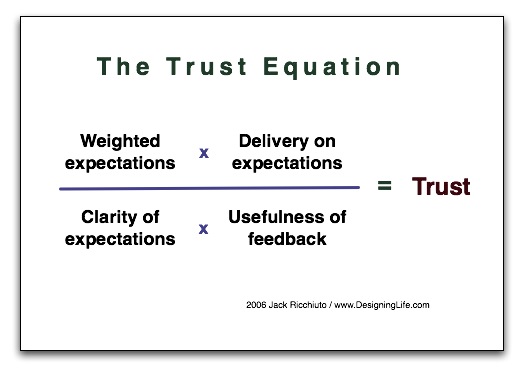
A successful leader must trust.  Being trustworthy is easy, giving trust away is hard.  Leadership in education or in any field requires those in a position of leadership to trust those that surround them.  The colleagues and employees, the roles and responsibilities laid forth in a job description, the trust that tasks will be completed in order to accomplish the goals of the organization.  Without trust there is no leadership.

Every interview I've been on has asked me; "What do you do if a teacher is not doing their job/meeting expectations?"  This is a tough question simply because without developing a relationship with this person it's hard to talk about trust, faith, and belief in the person that they can achieve the objectives/expectations of the position.  I always answer objectively and speak about facts but it's hard to speak about numbers and ideas without caring for the individual that this question is crafted for.

What's our take away from this?

Trust in leadership is all about empathy, can you be empathetic and effective at the same time?  The answer is a resounding yes.  And that yes is centered around the trust you build as a leader, trust in others and trust in the organization's success.

Friday, April 29, 2011

Top 10 list for 4/29/11

Top 10 List

10. Impress your friends with Educational Jargon Generator


9. A school district’s stand on homework.  Fascinating take and very revolutionary.  What’s your reaction?


8. TEACHING SECRETS:  Get back in touch with your inner Middle Schooler...


7. Cool web 2.0 tools for schools - What a GREAT resource!


6. In thinking about parenting, filtering and our online life


5. 101 Friday Puzzles great for problem solving and critical thinking http://goo.gl/3jS

4.  Study blue.  A very neat resource for creating resources for students.  There’s also an app for that!


3. 16 things I wish they had taught me in school, I’m especially fond of number 10.


2. What does “Being a great teacher” mean to you?  Great post http://goo.gl/8DQKs


1. How to make the PERFECT cup of coffee


Great videos for this week!

Mark Sandborn, great author from Fred factor says why you don’t need a title to lead


How to subscribe to things using your google reader


The “net generation” as learners


Learnitin5 is awesome!  Video on the value of feedback


The Flipped classroom:  I’ve been doing this for years, didn’t think it was revolutionary, just more efficient.  Now it’s revolutionary.

Friday, April 15, 2011

Top 10 resources for 4/15/11 TAX DAY!


The best resources found this week through twitter and my google reader.  Enjoy!

Top 10 List

10. Just for Fun Haiku Creator


9. Just say NO! to keynote and powerpoint


8. 5 Bookmark tools every educator should have


7. “Every lesson is a balance between something the students can already do & something they are working to master.”


6. What to empower students?  Expect more out of them


5. Things that will be obsolete by 2020:

and


4.A Google A Day: A fun way to hone your searching skills!

3. Why educators should be using twitter


2. 16 things I wish they would have taught me in school


1. The invisible leader:  A must read for anyone aspiring to lead in any way


Videos of the week!

I love this:  Students used Project Based learning to utilize a cross curricular project as well as a TON of technology....Building a restaurant!


WOW!  Just WOW!  When you identify a kid that is not paying attention in class it’s important to understand attention and just how much we as humans do pay attention.  Great video with many AH HA’s! for me


TMB Panyee - The true story of how innovation, determination can yeild tremendous success.


Words are worse than sticks and stones - good message wish it was appropriate for school....


Really good anti-bullying video

Sunday, March 13, 2011

How many F's are on your report card?

Background
I recently attended the Systems Thinking in Schools conference sponsored by the Ritenour School District, the Water's foundation and Washington University in St. Louis' school of social work.  


The conference was awesome and if you can schedule some time to visit this conference it is worth your time, effort and energy.  The coolest thing about this conference is meeting people doin the work of systems thinking from all over the world.  I met people from Canada, United Kingdom, and the Netherlands, it was truely a global conference.


The "F's"
Friday night's keynote session was from Dr. Andy Hargreaves.  It was EPIC.  Dr. Hargreaves was motivational, challenging and a fantastic speaker and presenter.  His new book is called "The Fourth Way" will cause readers to reimagine how people consider social and educational reform.


Andy Hargreaves presented on 15 F's that are the  "F"oundation of moving your organization (or school) to achieving "Beyond Expectations."  These F's are all characteristics of organizations that have been proven through research to be successful through many variables.  How many "F's" are on your leader or organization's report card?


15 factors that make your organization perform beyond expectations

The Fantastic Dream - MLK didn’t say I have a strategic plan...
    • If you want to be number 1, you won’t stay number one for long. You have to know what you want to be and why you want to be it.
    • Most leaders think it’s all about being faster, better, greater, but they do not know why they want that?!
    • Finland decided that they want “ALL our people to be inventive,” does the american education system have a "why?"
The Fear
    • Successful leaders and successful business march to the beat of a different drummer. As leaders we have to be okay with being different. The fear of being different and the accepting of that fact can become the motivation that creates greatness. When you reach that moment of fear, as a leader do you fight or flight?
Fight
    • Leaders fight for what they believe in. Great companies don't stand for good, they fight for great. Fighting is not for something or against someone, it's that internal perseverance to overcome adversity.
    • You will not achive your dream without opposition.
    • A great question is how far are we willing to let something fall while we fight for what we beleive in. For example in education: How much are we prepared to let our scores fall as we engage in this innovation!?
Fundamental Futures - Connect where you are going to where you have been!
    • Your vision and your future is connected to the past. Do you or your leaders recognize that? There is this trend in business and education looking for the silver bullet but there is no simple silver bullet for solving complex problems or creating successful organization.
    • There are three types of leaders in this world:
      1. People who have been there for ages and KNOW the culture of the community, the business and the customers.
      2. People who have been there as an assistant and move into the number 1 spot
      3. Parodical leader - use to work in the organization, left, but is still loyal and came back to lead.
Firm Foundations
    • Charismatic leaders that can't let go of their leadership. Successful organizations and schools have leaders that welcome the strength of those around them.
    • Before every charismatic leader is always an unsung, unheralded leaders that set the systems in place for success.
    • Creating firm foundations means connecting your beliefs about leadership to what you do in your organization. If that connection cant be made success may not be because of your leadership.
Fortitude
    • Don’t give up, get work done!
    • As leaders how do you treat the lowest status people in the community and at your organization?
    • Successful leaders and organizations have little trouble going into the darkest places to show that success can be achieved.
Counter"f"low - It' an F...sort of.
    • Be the fish swimming upstream. As a leader you must be willing to be different and go against the grain. Great organizations do the ordinary extraordinarily well.
    • Leaders don't shy away from resitance or that person that doesn't like you very much. Great organizations meet resistance head on. Successful leaders have fun solvin problems.
    • Love this quote from Dr. Hargreaves: "Great leaders like to perform uphill and against the wind."
    • Great leaders think outside of the box, while performing well inside the box.

Fast and Fair tracking

    • Short term targets with long term goals. The short term goals make the fast progress happen.
    • Fair means providing what students, coworkers need and leaders must exhibit flexible creative behavior to meet the needs of the organization or the classroom.
    • Great leaders set targets with their employees.
    • Does what we measure (test scores, productivity bottom line) reflect what we value instead of valuing what we measure?
Feasible growth
    • Great leaders set attainable goals. They remain focused on achieving objectives. Create measurable and sustainable change. THey are focused on meaningful growth and control it using systems to ensure quality is not lost in quantity.
High Fidelity
    • Great leaders fight for a cause that is bigger than themselves and their organization and all decisions and changes they make are done with that cause in mind.
Fraternity
    • When the going gets tough, when the bumps start to happen does your school or organization pull together, or splinter off? Great leaders create a team that stays strong.
Flair, flow, and flexibility
    • Great organizations have employees that never say "No - that’s not my job."
    • Great leaders create employees that are passionate about what they do.
    • Great leaders create employees that go with the flow.
    • Great leaders create employees that can do what is asked of them.
Fallibility
    • Great leaders don’t get too big for their boots.
    • Great leaders embrace failure! (not catastrophe of course)
    • Great organizations realize that if everything they are doing is all safe the organization is not innovating.
Friendly rivalry
    • Great organizations support "coopertition."
    • Great organizations invest heavily in their competition.
    • Great organizations and leaders recognize the need of the community is greater than the need of the one school or shop.
    • In England you have to spend 20% of your time HELPING other schools.
    • Great leaders have a strong belief and a MORAL responsibility to help the weak.
Fusion Leadership
    • Leadership is not a bunch of competencies or knowledge you can collect.
    • The Fusion must be through systems thinking
      1. Inner fusion of character styles and competencies
      2. With colleagues, ecologially diverse, surrounding yourself with people who are different than you.
      3. Fusion must happen over time.


Awesome!

Monday, February 28, 2011

You need a soundbite!

As a school leader, or a leader in any organization, create something you can put on a bumper sticker.  If you don't create a tag line, you can be sucked back into being a manager.  Some ideas include:


  • Learning everyday
  • All students can lead
  • Striving toward the goal
  • Meeting objectives
  • Loving the process
  • Better today than yesterday

What is yours?

Tuesday, February 22, 2011

Teacher Evaluation: Part 2

Creating the right climate

  • Clear goals and expectations for student achievement and classroom instruction.
  • Formats and structures for regular teacher interaction. (keep in mind that structures must be in place, training must have been completed so that this interaction is proactive and productive and not detrimental to the school community).
  • Formalized process for sustained professional development to ensure all staff have the skills necessary to attain goals.
  • Systems for formally monitoring and evaluating progress.
  • Allocation of resources to accomplish goals.
  • Collective, shared leadership to ensure goals and expectations are met.
  • Clearly articulated data-driven goals for student achievement and classroom instruction requiring the use of research-based strategies.
Image Credit:
http://mascmahs.org/files/images/advisers/adultshuddle.jpg


Resources:

  • Tomorrows leaders of our community meeting – Teacher evaluation: Chris Lindquist
  • ASCD article – Evaluations that help teachers learn
  • ASCD Education Update Vol 52 no.12 – Teaming up to lead instruction

Wednesday, February 9, 2011

PROOF! Time travel does exist!

This post is about grading...

What happened?
About 4-5 years ago we began a journey to reform our grading practices and implement district wide K - 8 a standards-based environment.  Through much change, courageous conversations and lots of bravery teachers began to see the "new" (as they called it) way of grading provided them with new insights into their teaching and grading practices.

We were on the road to greatness.  I "drank the Kool-Aid!"

Not to take too far of a detour but my teaching, assessments, and classroom interactions are much more focused, more meaningful and bottom-line kids are learning more and having fun, and better yet so am I!

Self promotion section:
My website to find more resources on how I use Standards-based grading (SBG): http://www.kirkwoodschools.org/faculty/mcgeech/
My resume with presentation I've presented on SBG and more: http://cmcgee200.blogspot.com/p/programs-and-presentations-facilitated.html
My dissertation resource centered around SBG: http://cmcgee200.blogspot.com/2011/01/dissertation-resources.html

1.21 Gigawatts Marty!!!!
So here's where the time machine comes in...  Overheard at a meeting the other day:
"How are we going to teach these kids responsibility if we don't put it into their grade?"
"How are these kids going to be successful in high school if they don't do their homework?"
"Kids will not learn (insert subject here) unless they practice 15-20 problems every night, and I cut that back."

That was it.  It's official, we've gone back in time.

Advice for Leaders
A piece of advice.  When implementing a new program, when instituting a large organizational second order change process (Read Fullan's Leading in a Culture of Change.)  Understand this process will take YEARS to complete and provide your teachers opportunities to continue to develop understanding.

Change, big change, happens over time and there will be opportunities to 'slip back' (typically called the implementation dip) into the way they know, they way that 'worked.'  Whatever your position is, care for them, understand they are uncomfortable and let them know you understand they are taking a risk.  Only through risk will true growth occur.

Setting a course
Here's to hoping we can right the ship, begin the conversations again and continue the journey.


Image credit:
BTTF: http://www.we-make-money-not-art.com/wow/backtothefuture_backtothefuture.jpg
Course: http://quityourdayjob.com.au/wp-content/uploads/2010/07/bttf2-date.png

Monday, January 3, 2011

You're just "Two Tents."

I met last week with my advisor from my doctorate program and my mentor.  One of the items of discussion that hit me was that I've become a "professional interviewer," one that makes the finalists but doesn't get picked for the job.  (For clarification I'm seeking an assistant principal position in and outside of my district.)

One of my flaws (of many I'm sure) is that I work very hard to do the best job I can do.  This does take an unorthodox commitment on my part to work well beyond the hours of my job.  Heck, I'm blogging right now.

Here's my point:  What I took away from the meeting was a description of my personality as "intense" and that I need to learn to "lighten up."  This (ironically) immediately made me think of the joke:


A guy went to a psychiatrist. "Doc," he said, "I keep having these alternating recurring dreams. First I'm a teepee, then I'm a wigwam, then I'm a teepee, and then I'm a wigwam. It's driving me crazy. What's wrong with me?"
The doctor replied, "It's very simple. You're two tents."


So, do you have any advice on how to balance high expectations of yourself, without being considered "TOO INTENSE"? (typed in caps lock to emphasize intensity.)

Have any advice for me?

Wednesday, December 22, 2010

What is Excellence?


I ran across this today on a conversation about perfection and it really hit me.  I have a feeling this will result in a more thorough blog post but I felt it timely to just be read as is:

Excellence is willing to be wrong. Perfection is being right.


Excellence is risk. Perfection is fear.


Excellence is powerful. Perfection is anger and frustration.


Excellence is spontaneous. Perfection is control.


Excellence is accepting. Perfection is judgment.


Excellence is giving. Perfection is taking.


Excellence is confidence. Perfection is doubt.


Excellence is flowing. Perfection is pressure.


Excellence is journey. Perfection is destination.

Is it better to be excellent or perfect?  I feel I am striving for perfection, when I should be focusing on excellence.


I needed this right now...

Thursday, December 2, 2010

The Opportunity of a Lifetime

Tonight


Tonight I sat in a classroom for my doctoral program and thought that it was going to be just another class.  I was wrong.  With a tremendous thank you to Dr. Craig Larson I had the experience of a lifetime.  I can honestly say I am changed forever from this experience.


I had the opportunity to sit in a room of superintendents, two of I knew, three I did not, and just listen and ask questions.  It was amazing.  The questions and answers were unscripted and unfiltered which made for an experience like no other.  Let me explain something to you, I love learning, but this experience sent me to a whole new level.  It was just amazing.


In the interest of sharing I also tweeted every memorable statement made by the panelists and compiled them below.  The whole experience opened my eyes and really made me so excited about great leadership in education.  It excited me to no end that I have chosen this profession.  This experience confirmed to me that this is what I want my life to be about.


The panel included:


Dr. Craig Larson - Former Superintendent of the Rockwood School District
Dr. Stan Lawrence - Superintendent of school for the Normandy School District
Dr. Kelvin Adams - Superintendent of St. Louis Public Schools
Dr. Cheyrl Compton - Superintendent of the Ritenour School District
Dr. Marsha Chappelow - Superintendent of the Ladue School district


Memorable quotes I posted on twitter (@cmcgee200)

  • As a Supt.  you have to be who you are.  You don't hunt a Supt. job, it finds you.  -S.Compton #edchat
  • As a Supt. you have to realize it's not about you.  It's about what's best for kids. #edchat
  • Learn everything you can learn, touch everything you can touch, in order to learn to prepare you for educational leadership.-K.Adams #edchat
  • I've always believed I should always take the most difficult and challenging job. -S.Lawrence #edchat
  • As a Supt.  The job is everything I thought it would be. -S.Lawrence #edchat
  • As a Supt. I wanted to work for people who were champions for children of poverty. -S.Lawrence #edchat
  • Smooth transitions are caused from asking hard questions but dealing in reality. -S.Lawrence #edchat
  • Bringing people together behind good marketing, successful issues and community revitalization will yield success. -S.Lawrence #edchat
  • When you take into account all the circumstances poverty brings, we have new challenges to uncover. -S.Lawrence #edchat
  • What do you do when your staff population doesn't reflect your student population? #edchat
  • We're going to find the best candidate, we don't believe the best candidate is white.  We actively recruit BEST teachers -S.Compton #edchat
  • Kids need role models of people who look like them. -S.Compton #edchat
  • I feel like people have less ownership of their pub schools because so many affluent dist send kids to private schools. -M.Chappelow #edchat
  • When I have a challenge I like to look at what are my chances for success -M.Chappelow #edchat
  • If we don't get more people going into education, we are in trouble, we are losing all the valuable candidates. -M.Chappelow #edchat
  • When we look to hire we evaluate learning potential and cultural sensitivity -K.Adams #edchat
  • The most important job in a school district is HR, putting the right people in the right places. -S.Compton #edchat
  • As a Supt. surround yourself with people who are smarter than you, my uncle said that wouldn't be hard for me. -S.Lawrence #edchat
  • Have a mind to understand, try to touch everything in your dist, work in a small district when starting out to learn more. -K.Adams #edchat
  • Learn to ask the right kind of questions and rely on your experience -K.Adams #edchat
  • Ed. Leadership: Ask more questions than trying to come to your own conclusions. -K.Adams #edchat
  • As a Supt, I'm not the keeper of all the knowledge.  I get good at asking a lot of questions. S.Compton #edchat
  • If you hire thoroughbreds, you need to let them be thoroughbreds.  It takes talent to manage talent. -S.Compton #edchat
  • As a Supt.  You are making decisions that are connected.  You can't make a decision in a silo. M.Chappelow #edchat
  • As a Supt.  we need to connect with the work by helping with teacher evaluation and supporting building principals -S.Compton #edchat
  • As Supt we GET what the priority is when we are in the classroom supporting teachers -S.Compton #edchat
  • As Supt.  I think our role needs to be supporting building principals, we are in a service industry. -K.Adams #edchat
  • School site is the important place, the classroom is the most important place. -K.Adams #edchat
  • Central office should be called the "campus support center" -S. Lawrence #edchat
  • As a Supt. my value to you is to support you and help you get the job done.  -S.Lawrence #edchat
  • Some of the decisions that were made were not popular, that's leadership.  -S.Lawrence #edchat
  • Push-back and criticism are part of leadership -S.Lawrence #edchat
  • Kids deserve the very best. -S.Lawrence #edchat
  • We have an obligation as administrators to help struggling teachers.  Troops notice how the generals treat the wounded. -S.Lawrence #edchat
  • What "red lights" have you had to run in your tenure in ed leaderhsip? #edchat
    • I really don't think you can lead without running every red light. -K.Adams #edchat
    • Don't see as red lights, every decision "what needs to happen to align our work so they can be who they want to be."-S.Compton #edchat
  • They might need to be a nurse, they might need to be a brain surgeon not every one needs to be a principal or a teacher. -S.Compton #edchat
  • Sometimes good is not good enough, we need great. -S.Lawrence #edchat
  • We need OUTSTANDING leaders, teachers, and staff for the value of our children's lives -S.Lawrence #edchat
  • As a Supt. I over-invest in my school board. -S.Lawrence #edchat #cpchat
  • I have a preference to work with intelligent people. -S.Lawrence #edchat #cpchat
  • Supt.: Never take a job when it's a 4-3 vote.  You need unanimous support.  -K.Adams #edchat #cpchat
  • Supt: board meeting takes an hour, that's too long, I've been communicating about whats going on, they should know -K.Adams #edchat #cpchat
  • I was told elected boards don't work, it must be your job to communicate with your board, then it will.  -K.Adams #edchat #cpchat
  • Were reculturing what we are doing.  Good can be the enemy of great.  -M. Chappelow #edchat #cpchat
  • When you hire good people there is a mass of people asking: "why do we do it that way?"-M.Chappelow #edchat #cpchat
  • We're growing, we are getting less money through AV, there's the crunch in education -M.Chappelow #edchat #cpchat
  • When a district loses trust, you have to gain it back, it's emotional process -M.Chappelow #edchat #cpchat
  • I like to plant seeds, things don't more fast in education. -M.Chappelow #edchat #cpchat
  • Having an attitude of proactively planning for the future is my key to success. -M.Chappelow #edchat #cpchat

Reflection:

Reading back through these statements I try to grasp exactly what happened tonight. I want to say I think the 25 students that to the opportunity to meet, question, and learn form these amazing leaders have changed permanently.  We learned valuable lessons, but I think more than anything, we learned about hope.  Hope for a greater education for the next generation.  We were blessed to have this opportunity to learn from such AMAZING leaders and get a small glimpse of what being a true leader means.


Some of my favorite comments from tonight include:

Learn everything you can learn, touch everything you can touch, in order to learn to prepare you for educational leadership.-K.Adams 

As an aspiring administrator this validated my path and reminded me that there is no bad learning experience, there is always something I can learn and take away.

Sometimes good is not good enough, we need great. -S.Lawrence

I think about this everyday.  That lesson that I did last year is not good enough for my kids this year.  I need to improve what I do everyday.  One of my favorite quotes is "Never let good stand in the way of being great."

When I have a challenge I like to look at what are my chances for success -M.Chappelow

This goes back to my blog post on solving problems in schools.  Every time I'm faced with an obstacle the bottom-line to accomplishing the task at hand is in your perception of the obstacle.  Is it a problem that requires a solution, a constraint that I will have to live with moving forward, or an opportunity to improve the organization.  I will always consider an obstacle as an opportunity to learn, grow, and get better at what I do everyday.

If you hire thoroughbreds, you need to let them be thoroughbreds.  It takes talent to manage talent. -S.Compton

WOW!  Powerful statement.  If we hire great teachers, how can we as educational leaders inspire, motivate and support them to be all that they can be (do I have to pay Army for that statement?)?  I love this quote because it shows the importance of human resources and the role it plays on the development of a great school.

FInally, I leave you with a GREAT song/video, thank you to Dr. Lawrence who mentioned it tonight.