Showing posts with label teacher. Show all posts

Tuesday, April 1, 2014

Summary of "Remodeling Literacy Learning"

Cross Posted on my work Blog here: http://wgsdsciss.blogspot.com/

Find the original PDF here:  http://www.literacyinlearningexchange.org/remodeling-together


The report started with a survey:
The "NCLE conducted a national survey of educators of all roles, grade levels, and subject areas to find out where we stand as a nation in the following areas:
• What kinds of opportunities have educators had to learn about the new literacy standards?
• What kinds of professional learning are most powerful in supporting teachers as they implement changes in their classrooms?
• How are schools and districts approaching the transition to the new standards, and how involved are teachers in planning and implementing that transition?
• Are teachers working on the change individually or collectively, and how does that impact how well the change is going?
• What role is teacher expertise playing in translating the broad goals of the standards into specific learning experiences for students?"

Page 4 FINDINGS:

PAGE 8 FINDINGS:

pg. 9 "Data from NCLE’s 2013–14 survey demonstrate the potential of the teacher-driven, capacity- based model of educational change. Put simply, the transition to the new standards seems to be going best when teachers are highly engaged in the process and have time to work together to use their professional expertise to bring all students to higher levels of literacy."

pg. 11 "In our 2012 national survey on teacher learning, we asked educators to identify their single most powerful professional learning experience of the past 12 months. The number-one choice by a large margin was “co-planning with colleagues,” cited by 22% of respondents. Coming in second, chosen by 13% of respondents as their single most powerful professional learning experience, was “meeting regularly with a collaborative inquiry group.”"

pg. 11 "Respondents could choose up to three reasons, and the top three all speak to the power of professional collaboration to impact classroom practice:
• Helped me create new lessons, materials, or instructional strategies for immediate use (selected by 59% of respondents as one of the top three reasons the learning was powerful)
• Provided opportunities for active learning, discussion, and reflection on my practice (34%)
• Provided opportunities to collaborate with colleagues/to create a support network (32%)"

pg. 11 "This result is consistent with extensive research showing that educators find professional learning most powerful when it affords them the opportunity to actively exchange ideas with colleagues and test them in their practice immediately."

pg.11 Working with colleagues is GOOD!

p.12 "This year’s data show that over the last year teachers have become even more isolated from each other’s professional expertise, even as they are being asked to undertake the large, complicated task of CCSS implementation."

pg.12 DATA!


pg.12 "Good teaching requires deep understanding of the goals we are trying to help students reach, analysis of their current level of understanding, and careful design of learning experiences, all of which are tasks that require professional time outside of the classroom and are best accomplished with the support of colleagues."

pg. 13 "Beyond being given little time to work through the shifts called for by the standards, most teachers reported having little voice in how their school is making the transition."

pg. 13 GRAPHIC

pg. 15 "Compared to teachers who are working in isolation, teachers who had participated in collaborative work with colleagues around the standards were twice as likely to rate themselves as well prepared to help their students meet the standards and also much more likely to report having already made moderate or significant changes in the content of what they teach and methods of how they teach it in response to CCSS goals."
pg. 16 "Research has consistently demonstrated the value of teacher collaboration in improving student learning,"

p.16 Keys to effective collaboration
"(1) Deprivatizing practice: Teachers open their doors and their briefcases to share lessons, actual teaching, and student work with each other, so they can learn from each other’s successes and, perhaps even more important, failures.
(2) Enacting shared agreements: Colleagues agree at a concrete, specific level on the student outcomes they are working toward and how to assess them.
(3) Creating collaborative culture: Teachers demonstrate accountability to each other by following through on trying new instructional practices between meetings and reporting back on results, and they trust each other enough to engage in hard conversations about what works.
(4) Maintaining an inquiry stance: Experimentation is grounded in evidence and focused on clear student outcomes.
(5) Using evidence effectively: Teachers decide whether a lesson or practice worked and how it could be improved by analyzing evidence from students, from test scores to samples of student work.
(6) Supporting collaboration systemically: Teachers’ shared work receives formal support including protected time, relevant and timely data, and leadership involvement."

pg.18 Teachers need more time
pg. 18 "Looking at practices like lesson study in Japan and periodic curriculum reviews in Finland points to some answers: these are structured, purposeful tasks which immerse teachers deeply in the substance of what they are teaching, the best methods to get concepts across to students, and how best to assess student mastery. Most of all, these structures provide a lab-like setting, an ongoing cycle in which ideas are developed, tested, and refined, tapping the collective insight and practical experience of multiple teachers to strengthen learning for all students."

pg.19 "We then looked at whether teachers who frequently engage in specific collaborative tasks report being better prepared to teach the standards."

pg.19 What works when teachers work together

pg.21 "Professional learning that is embedded in the real work of instruction is far more likely to lead to desired changes. Such tasks let teachers pool their insights and experiences and adjust their practice in real time"

pg. 22 "When asked specifically how big of an impact standards are having so far on classroom practice in terms of both what is taught and how it is taught, solid majorities of teachers across subject areas reported a moderate or significant impact on HOW material is taught. There was more variance in the reported impact on WHAT is taught."

pg. 23 "The most consistent shift reported by teachers in our survey is in spending more time having students defend arguments with evidence, which more than three-fourths of teachers in all subject areas report doing more of this year in response to the CCSS."

pg. 23 "The bottom line is that these standards ask students to work collaboratively and analyze evidence coming from multiple kinds of texts that cross disciplinary lines. This is going to be difficult to pull off if teachers of different subjects remain isolated from each other and so many have minimal to no time to work together."

Recommendations


pg.28 "Recommendation #1: Provide educators with more shared time for planning and professional learning about elevating literacy learning for all students."

pg.29 "Recommendation #2: Encourage and support educators to take initiative in designing and using innovative literacy teaching resources that are appropriate for their students, and not rely on prepackaged programs or solutions."

pg.29 "Recommendation #3: Draw upon the insights, skills, and experience of everyone with a stake in improving literacy learning to help students achieve more."

Pg 29-30 HOW TO:

"Principals and School Leaders Can . . .
• Allocate and protect time for teachers to work together in developing literacy instructional practices and in analyzing student work.
• Provide training, support, and structures that make teacher collaboration time purposeful and effective.
• Build trust among staff by participating in groups not solely as an instructional leader, but also as a collaborative colleague.
• Respect the expertise of teachers in building-level decisions about literacy teaching materials and curriculum and in the application of formative and summative assessment data to instruction.
• Monitor and understand emerging research about literacy learning and educator collaboration, making this a focus for their own professional growth.
• Make literacy learning in every subject a school-wide priority and establish a structure for staff-wide participation in planning and monitoring progress toward the attainment of student literacy growth goals."

"Teachers and Other Educators Can . . .
• Engage in focused, purposeful collaboration with colleagues (both in person and online) about instructional shifts that can be made to deepen student literacy learning in every class.
• Open doors and share practice so that others can learn from both successes and failures.
• Commit to continuous, collaborative assessment and analysis of student work and agree to
shift their strategies as they learn more about students’ progress as literacy learners.
• Demonstrate accountability to each other and to students by developing and documenting
shared plans for deepening student literacy learning across a school year.
• Build professional capacity by choosing literacy teaching strategies and materials based on
learning from collaborative activities with other teachers.
• Tap the literacy expertise that resides in all subject areas and job roles (including coaches,
librarians, and administrators) to build a coherent school-wide literacy experience for students."

Wednesday, September 7, 2011

Learning Timeline

Currently wrapping up my doctoral studies, an assignment was to think back to your educational career.  Remember the things that shaped you, molded you, and created the leader, learner, and educator you are today.  Keeping that in mind I went searching for the perfect web 2.0 tool to create my educational timeline.  I settled on Timetoast.com.


Although I like the interface and the ability to add pictures, links, etc.  I struggled with the inability to PRINT and analoge copy.  It was a fun assignment and seeking the right tool was even more fun.

Special thanks to Bob Dillon (no not that Bob Dillon), Justin Tarte and David Kapular (Top 10 timeline tools was a great resource) for supplying some of the resources and inspiration.


Friday, May 13, 2011

Learning about Leading from a General

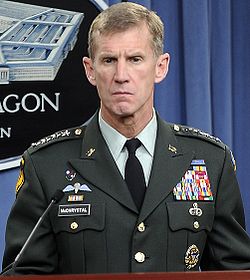
I watched this TED talk by General Stanley McChrystal and was impacted by some of the words he said when thinking about leadership, listening, leading, and trusting.

How can educational leadership learn from these very military ideas, from an uber-military person?  Simple.

General McChrystal has some real poignant moments in his TEDtalk for me that got me thinking.

1.  Leaders can let you fail, without being a failure.

I was in a job interview yesterday and kept thinking about this statement.  A good coach, facilitator, administrator and/or leader is someone that will be there by your side.  They will be there watching you fail, allowing you to fail, facilitating the learning process, reflecting with you, but never let you be a failure.

Listen, I know, failure sucks.  But there is beauty in failure.  I learned about it the tough way and began to really believe in what I do day in and day out to make myself a better teacher and better person.

As a leader you have to allow for failure but most importantly be there for your students, colleagues and staff and support them through that process.  Great leaders can let you fail.  Great leaders will support you through trying something new in your classroom, being their for you to reflect and helping you get better in the end.  Failure is not a destination, it's often just a detour on the road to where you want to go. We often find that to ever truly succeed we must at one point fail, the key is to surround yourself with great leaders that support you through that process and celebrate your growth in the end.

Some great resources on failure and how to change your view and celebrate it instead of lament it:

Fringe benefits of Failure - J.K. Rowling

On being wrong - Kathryn Schulz

Then What.... - Frank Gehry

Kinder, gentler model of success - Alain de Botton

What's our take away from this?  

As a leader we must support those around us, celebrate their victories of course, but as those of us learning about leadership know, it's more important to celebrate the failures.


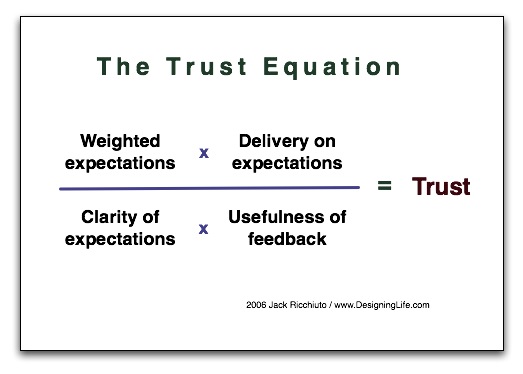
2.  A leader is the leader NOT because they are right, but because they are willing to trust.

A leader doesn't get into his/her position all on their own.
A leader is not a leader if they look behind them and no one is there.
A leader is a leader not because they call themselves one, but because others believe in them.

A successful leader must trust.  Being trustworthy is easy, giving trust away is hard.  Leadership in education or in any field requires those in a position of leadership to trust those that surround them.  The colleagues and employees, the roles and responsibilities laid forth in a job description, the trust that tasks will be completed in order to accomplish the goals of the organization.  Without trust there is no leadership.

Every interview I've been on has asked me; "What do you do if a teacher is not doing their job/meeting expectations?"  This is a tough question simply because without developing a relationship with this person it's hard to talk about trust, faith, and belief in the person that they can achieve the objectives/expectations of the position.  I always answer objectively and speak about facts but it's hard to speak about numbers and ideas without caring for the individual that this question is crafted for.

What's our take away from this?

Trust in leadership is all about empathy, can you be empathetic and effective at the same time?  The answer is a resounding yes.  And that yes is centered around the trust you build as a leader, trust in others and trust in the organization's success.

Tuesday, May 10, 2011

Using Lucid Charts in the classroom

Background

I teach 6th grade science and reading strategies.  With every reading strategy I teach a 21st century skill associated with that strategy.  My reading strategy for this week is making connections between texts.  A text-to-text connection.


Other posts I've done:
Typewith.me
Commenting on a blog
Voki
Infographics
Wallwisher

I have been seeking new ways to visually show making connections outside of pencil and paper and wants to show the connectedness of print, media, and other text based materials.  Then along came Lucid charts.

Lucid charts is best described as a online, FREE, web based, flow chart creator.  It has the capacity to work colaboratively and publishes a number of ways.  So far, to me, it has WAY more capabilities than my little 6th graders can utilize but they loved the flexibility and creativity they were afforded by the program.  I thought it was awesome and the kids thought it was very cool too.  My tech specialist that were watching me use it were so intrigued they got on right away and created an account.  Very cool!

Lesson Plan
  • Teach making connections: text-to-self (see the digital versions and student products here)
  • Teach making connections: Text-to-text using Lesson 46 in the daybook activity
  • Give feedback on daybook lesson
  • Provided student an opportunity to demonstrate making connections using the book they are currently reading
  • Give feedback on making connections using their book
  • Create a flow chart using lucid charts about their day today, set up how we can use this to make connections
  • Give feedback on flow chart
  • create connections model for students to demonstrate how the connections should be made and provide guidelines
  • My model is the image located to the right here->
  • Have students make connections using Lucid charts following key provided.

Set up

I had never used lucid charts but heard about if from Larry Ferlazzo's blog.  I'll tell you soemthing, if Larry likes it, I like it.  That's the bottom line.  I jumped right in plaued with it for a couple minutes and had no problem seeing endless possibilities for thsi free service.

  • made copies of Lesson 46 in daybook.
  • made copies of my model for the final days activities
  • Reserved two classes on two days of the computer lab
  • Enjoyed watching the creativity flow!

Evidence of student work

This being the first time I completed this task its hard to discuss what and how it would be scored.  

There are two separate entities here to be assessed:

1.  Is the student capable of making connections usin the book they are reading (curriculum item).
2.  Can the student utilize a flowchart creation application to create a visual puzzle of the book and connections they are making.


Student work: (I did notice some of the images didn't translate to the finished product, you'll get the drift if you see a large blank spot, that's where an image was at one time.)


Just fun!


One of my students even made a flowchart of the movie The Black Swan.  FUN!

Friday, April 29, 2011

Top 10 list for 4/29/11

Top 10 List

10. Impress your friends with Educational Jargon Generator


9. A school district’s stand on homework.  Fascinating take and very revolutionary.  What’s your reaction?


8. TEACHING SECRETS:  Get back in touch with your inner Middle Schooler...


7. Cool web 2.0 tools for schools - What a GREAT resource!


6. In thinking about parenting, filtering and our online life


5. 101 Friday Puzzles great for problem solving and critical thinking http://goo.gl/3jS

4.  Study blue.  A very neat resource for creating resources for students.  There’s also an app for that!


3. 16 things I wish they had taught me in school, I’m especially fond of number 10.


2. What does “Being a great teacher” mean to you?  Great post http://goo.gl/8DQKs


1. How to make the PERFECT cup of coffee


Great videos for this week!

Mark Sandborn, great author from Fred factor says why you don’t need a title to lead


How to subscribe to things using your google reader


The “net generation” as learners


Learnitin5 is awesome!  Video on the value of feedback


The Flipped classroom:  I’ve been doing this for years, didn’t think it was revolutionary, just more efficient.  Now it’s revolutionary.

Monday, March 14, 2011

Top 100, WOW!

WOW!

Special thanks to online degrees for considering and listing my blog for the Top 100.  I am truly grateful and honored to be listed.

Some of who I consider to be the best of the best are on this list.  I am humbled to be in their company.

Please take time to check out the list, add some of them to your reader, you will not be disappointed.

Please pay special attention to @justintarte (Herr tarte), @thenerdyteacher (The Nerdy Teacher), @JPPrez (Bits and Bytes), and @stumpteacher (Stump the Teacher) the coolest Jedi I know.  You will not be disappointed!

ADDENDUM:

Due to recent discussion and blog posts my links and recognition to this list has been removed.  Although the list is comprehensive, the people who put in the time and effort to create and publish the list are just doing their job, I, and many others feel that the motives are less than pure.

I am happy and grateful to be considered.  I am happy to be on the list, the list has brought new people to my blog and a new platform to share with great educators out there.  Thank you to all who support me in the endeavor of collaborating.  I hope that we can find a way to recognize great educators for doing great work and keep the motivation pure.

Until the next time we colaborate....

Thursday, February 24, 2011

Teacher Evaluation: Part 4 (Final piece)

Final Piece:

Having been evaluated by adminsintrators for 10 years, and seeking to understand teacher evaluation better I'm still wrapping my brain around what are considered "best practices."  Somethings I believe, some things I know, and some things I think you find out on the job, doing the job.  Much like coming out of undergrad into a classroom there is no set design on how to evaluate teachers.  There are some amazing tools that districts have created but there are no universally agreed on structures.  So how is an educational leader to proceed?

Over the last few Blog posts I've been wrapping my brain around what it means to "evaluate a teacher."  I've have lots to learn and much more research to do, but some of the things i have learned will/might beneift others and open conversations.

My final installment on Teacher Evaluation:

Knowledge base is key 

This gives you common language and a common place to being conversations and bring about change.

Create Capacity

Creating capacity means enhacing the ability to move a school, teacher and community forward.  Creating the right environment for growth to occur, similar to tending for a plant (water, sunlight, oxygen, etc.).  Sir Ken Robinson had a great TED talk on this and is still something that I consider to be the foundation of revolution within our education system.


Have a Plan  

Without a plan you may have growth, but it will be by accident.  Doug Reeves created the Leadership for Learning framework (below) and I cannot think of a better explanation of how professional development and teacher evaluation commingle to assess student achievement.


Teacher evaluation is a great opportunity to assess fidelity of implementation of your school or district's mission and vision.  It provides you with an opportunity to assess if your professional development is working on a whole, or if you are 'just lucky.'

Profesional development plan

  • Jointly determine goals with agreed upon steps to strengthen skills
  • Provide mentoring when needed or asked.
  • Provide a timeline for reevaluation.


Ensuring Teacher Quality

  • Creditability in the system used to evaluate teachers (How's your PBTE?)
  • Be able to answer the statement: Here’s how I know we have good teachers…
  • Consistent definition of good teaching
  • Shared understanding of good teaching
  • Have skilled evaluators
  • Promote professional development
  • Develop a program for evaluators that Familiarizes self with the structure and framework for teaching, Planning and preparation, Classroom environment, and Instruction.


Professional responsibilities

  • Ability to recognize sources of evidence for each coponent and element
  • Able to interprete the evidence against the rubrics fr each component level of performance
  • Calibrate judgements agains those of the collagues ( adminsotrs collaborate on what good teaching means to them.)

Resources:


  • Tomorrows leaders of our community meeting – Teacher evaluation: Chris Lindquist
  • ASCD article – Evaluations that help teachers learn
  • ASCD Education Update Vol 52 no.12 – Teaming up to lead instruction

Wednesday, February 23, 2011

Teacher Evaluation: Part 3

Continuing some thoughts I've been having about teacher evaluation brought me to think about the process.  All the steps along the way of being "observed and evaluated", those we as teachers or administrators often overlook.  The word evaluate seems to set up an us vs. them mentality, there must be a better way to describe the process of working alongside teachers to improve student achievement.  Here are some thoughts on the process...


Pre-observation
  • Discuss the lesson goals and objectives.
  • Discuss the instructional strategies and activities.
  • Discuss the plan for assessing student achievement.
  • Make sure there are a prescribed set of questions aimed at forming administrator understanding of the complete lesson.
  • MOST IMPORTANT: review the process, communicate the process, communicate expectations of the process


Planned observation
  • Plan the time over the duration of the lesson (might be a couple of days) to see introduction to closure.
  • Script the lesson. (This is a HOT topic right now it seems everyone has their own way of doing it, I don't know if I've found "my way" yet, but I'm not sure writing feverishly everything that is said in the classroom will cause me to miss something that may be more valuable)
  • Document times for each transition.
  • Use a format that is easy for you to write comments.
  • Write down every question the teacher asks (cross reference later for DOK).
  • Number times a student is called on.
  • Document wait time.
  • Document gender/ethnic background of students called on.
  • Document strategies used to reach students who are unresponsive.
  • Use of probing  to elicit higher level responses.
  • Classroom environment
  • Number of students engaged
  • Seating arrangements
  • Collaborative groups and how they are determined
  • Stimulus in the room
  • Closure or recap of learning goals


Don't leave the observation room until key facts have been documented and feedback has been e-mailed to the observe.


Post observation
  • Allow teacher time to reflect on the lesson to facilitate meaningful conversation.
  • Copy script and give one to the teacher (script conversation again).
  • Complete instrument based on planned observation.
  • Create leading questions to open conversation.
Resources:

  • Tomorrows leaders of our community meeting – Teacher evaluation: Chris Lindquist
  • ASCD article – Evaluations that help teachers learn
  • ASCD Education Update Vol 52 no.12 – Teaming up to lead instruction


Tuesday, February 22, 2011

Teacher Evaluation: Part 2

Creating the right climate

  • Clear goals and expectations for student achievement and classroom instruction.
  • Formats and structures for regular teacher interaction. (keep in mind that structures must be in place, training must have been completed so that this interaction is proactive and productive and not detrimental to the school community).
  • Formalized process for sustained professional development to ensure all staff have the skills necessary to attain goals.
  • Systems for formally monitoring and evaluating progress.
  • Allocation of resources to accomplish goals.
  • Collective, shared leadership to ensure goals and expectations are met.
  • Clearly articulated data-driven goals for student achievement and classroom instruction requiring the use of research-based strategies.
Image Credit:
http://mascmahs.org/files/images/advisers/adultshuddle.jpg


Resources:

  • Tomorrows leaders of our community meeting – Teacher evaluation: Chris Lindquist
  • ASCD article – Evaluations that help teachers learn
  • ASCD Education Update Vol 52 no.12 – Teaming up to lead instruction

Monday, February 21, 2011

Teacher Evaluation: Part 1


I have been exposed to a number of meetings, readings and conversations recently around teacher evaluation and the teacher evaluation process.  I thought about covering that over the next few blog posts.  Here's blog post number 1:

Ideas surrounding Teacher Evaluation:

Effective leadership requires
  • For administrators - Communication, Visibility and Accessibility
  • For teachers - Commitment to collaboration


Administrators in their role as educational leaders:

  • Build a common vision, language and knowledge base.
  • Focus on learning not teaching.
  • Establish a climate of trust.
  • Get into the classroom for formal and informal observations.
  • Always leave a note for the teacher after being in their room.
  • Provide a weekly e-mail to the whole staff communicating generalities about what was observed.
  • Ensure professional development that is job embedded, highly effective and spreads best practices.
  • Create a curriculum leadership team that includes teachers, community members, instructional coaches, and administrators.
  • Share observation and evaluation responsibility to a team of educational leaders.
  • Create effective instructional leadership through conditions that allow teachers to be successful, finding ways to monitor progress, providing feedback, and celebrating successes.
  • Are committed learners and are humble enough to support teachers and not speak from a pedestal.
  • Are lead learners and model learning for others.
  • Show support for teachers by carving out time during the day for teachers to collaborate.
  • Analyze data from a variety of sources to identify overarching achievement goals and drive important efforts within and across content areas.
  • Have strong knowledge of research-based, student-centered instructional methods and model the use of these strategies every opportunity you can.
Cartoon credit: http://www.cartoonstock.com/newscartoons/cartoonists/rha/lowres/rhan597l.jpg
Idea Credit:
  • Tomorrows leaders of our community meeting – Teacher evaluation: Chris Lindquist
  • ASCD article – Evaluations that help teachers learn
  • ASCD Education Update Vol 52 no.12 – Teaming up to lead instruction

Saturday, January 8, 2011

Focus on the Now!


As we begin the second semester I am bombarded with many teachers and students saying “XX number of days left until summer break.” 

I get distracted by countdowns, I feel they lessen the importance of the now and place attention and focus on what is to come.  I struggle with this concept.  

Now is good enough for me, now is important to me, I need to focus on the now.

Now is the attention and the focus I should give to my students, my school and my passion: Teaching.

If I were going to make a countdown to hang in my room it would read:

ZERO days left, Focus on the now!

And then I would play this song by Van Halen and every 6th grader would look at me and ask "Who's this?"


RSCON11 Keynote Presentation: The Networked Teacher


Today I was working on lesson plans when a well-known educator (Shell Terell @shellterell) tweeted about the keynote speaker (Dr. Alec Couros) beginning in 10 minutes.  The presentation was oing to be on “The Networked Teacher.”  I wasn’t doing anything so I figured I’d log in, give it a listen while I went along with planning, after all it was free.  Next thing I know it’s an hour and a half later and I haven’t planned a thing.  It’s was awesome:

The chat from the educators who were involved can be found here: http://goo.gl/7VEw3

His presentation resources are here: http://goo.gl/ARHaK I’m going to highlight a few of them here…

1.  Tools that exist for free on the web make it too easy not to network in some way.  Working alongside some of the best of the best makes you a better teacher.

2. The monopoly is ending – too much is free and too much is open to everyone, people are less held up in their classrooms doing only what they know.  Teachers are starting to reach out to other teachers across the world to share resources.

3. We are smarter together – If we all continue to build the collective intelligence items on a DOK of less than 2 will be simply something we call can easily find and we can devote more time to sharing at a deeper level.

4. Some fo the best teachers aren’t our teachers – you have to be willing as a teacher to know what you are good at, what you know, and not be afraid to go out and bring in or go to the best of the best to teach our students.

5. Geography doesn’t matter – There’s skype, google chat, etc. to go to others and bring people from all over the world into the room.  

6. Audience makes a difference – Don’t be afraid to publish your thoughts on the web.  You never know when an idea can find an audience and go viral.  The passion to collaborate is necessary.

7. Sharing is vital to learning – in today’s world we learn and grow more in a collaborative environment.  The sharing of one’s ideas and publishing of not only how you teach but how you learn benefits the common good.

8. Network literacy and digital literacy – As a crucial part of 21st century skills we must educate students, teachers and community about how to interact in a global, flat, and digital society.

9. Networks allow us to make the world better – Being careful not to fall into a world of passive activism networks allow us to help each other out and build a Professional (personal) learning Network (PLN) that will enable use to be better educators for our students

10. The end of education and the beginning of learning – As we continue to revise what education looks like in the 21st century it is paramount for us educators to strive to open doors for others, be a gateway to a better world.  Education is no longer a “sit and get” process like it was when I went to school.  Learning needs to happen at school and learning can’t happen without collaboration.


Resources I learned about:


Twitter chat schedule: http://goo.gl/NJ0HG


Creative Commons: http://creativecommons.org/

Be a mentor to others, or be mentored: http://www.edupln.com/group/theteachermentoringproject

Other presentations from the conference can be found here: http://reformsymposium.com/conference-details/meet-the-presenters/


Ridiculous Youtube videos:

Sharing the moral Imperative: http://k12onlineconference.org/?p=610

Virtual Choir introduction: http://www.youtube.com/watch?v=zyLX2cke-Lw

If you are on twitter and would like to check out the notes from the conference search twitter hashtag: #rscon11

Alec’s brother tweeted this video: http://www.youtube.com/watch?v=n0P4NZ4Mwmg

Alec Couros Self slanderous behavior: http://www.youtube.com/watch?v=4jXZR3pWKxQ


Slides I loved